
Be Like Esther
Let us each be the hero of our own story this Purim

Dear Friends,
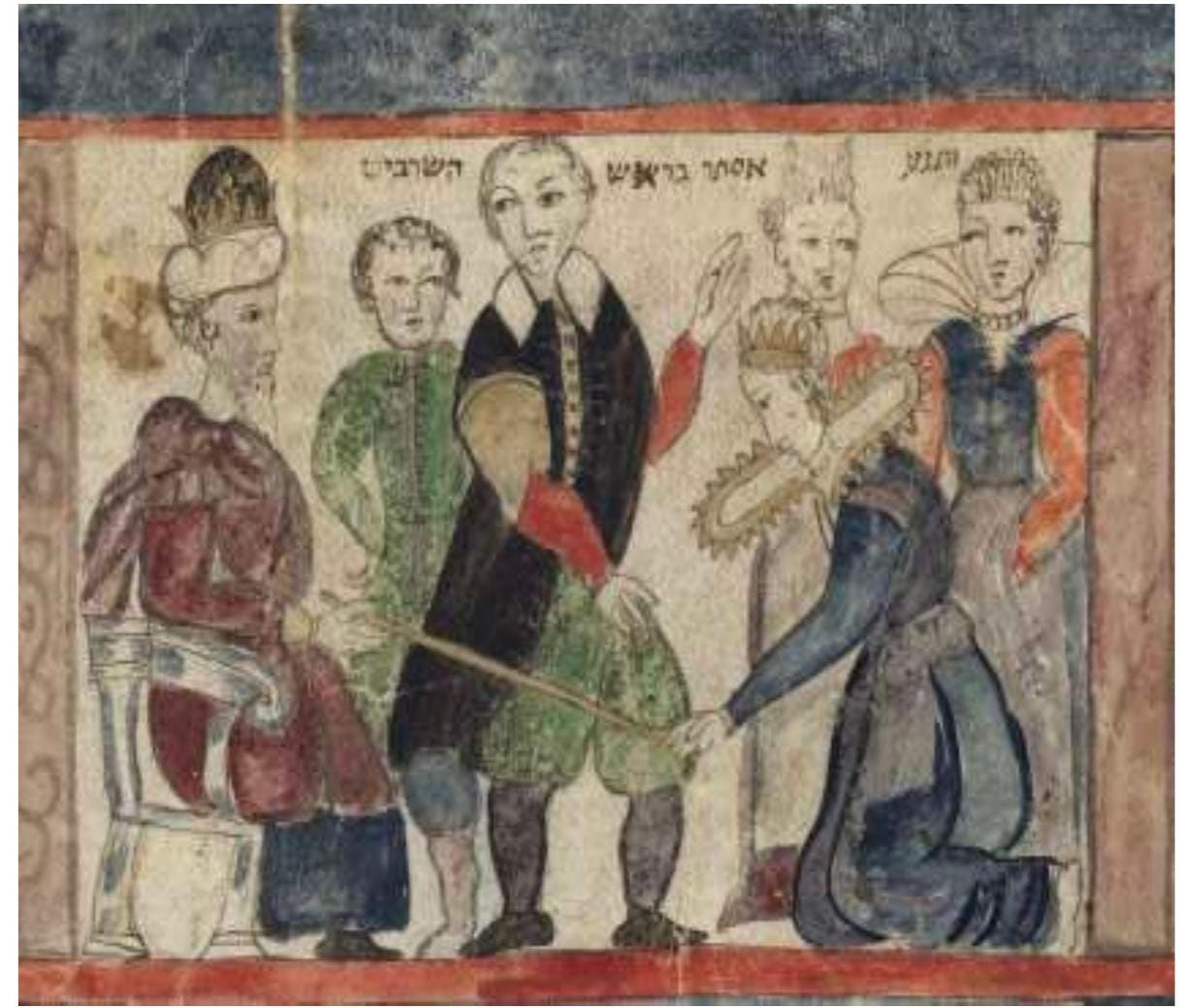
The full moon arrives tonight, and the Festival of Purim arrives with it. Purim is a holiday of masks and costumes and unbridled silliness, during which we read Megillat Esther, the Book of Esther. It is a fanciful, farcical story written some 2,400 years ago and set in the Palace of Shushan, the capital of ancient Persia. Haman, the wicked Prime Minister, persuades King Ahasuerus that all the Jews of his kingdom must be annihilated. But Mordechai the Jew and his niece Esther turn the tables on Haman. While hiding her Jewish identity, Esther becomes Queen. Esther arranges a special banquet with Haman and the King, at which she reveals her Jewish identity and explains to the King that Haman wants her killed, along with all of her people. The King turns on Haman, who is hung on the gallows he had erected to hang Mordechai. The Jews of Persia defeat their enemies, live in peace and honor, and are told to celebrate Purim forevermore.
This story is fiction, filled with humor and irony, and is a Hebrew literary gem. It brims with mythic archetypes: the foolish king, the wicked villain, the wise uncle, the beautiful heroine. There is no evidence that the tale told in the Megillah has any historical basis.
Dangerously, many people confuse myth with history, and in doing so cause great harm and evil. Jews who take this story literally use it to justify murderous attacks against present day enemies. In 1994, the infamous Baruch Goldstein chose Purim to walk into a mosque in Hebron and slaughter 29 Muslims, thus in his mind reenacting the revenge the Jews of ancient Shushan took against Haman’s forces in the Purim story. After Hamas’ genocidal massacre of Jews on October 7, 2023, the Purim story was again invoked as Biblical and timeless justification for ruthlessly destroying enemies who would destroy us.
This Purim it is especially tempting to mix myth with current events. Iran, which is present-day Persia, has been calling for the utter destruction of Israel since Iran’s Islamic Revolution of 1979. The ancient story of Haman could not be more resonant than at this moment, as Israel seeks to destroy the power of the Islamic state of Iran, which has literally demonized us for decades and made our annihilation the central platform of its regime.
I am not feeling festive this Purim. The current war is causing great devastation, its motivations and merits are debatable, and its ultimate outcomes cannot be predicted. The impulse to simplify this conflict by analogizing it to the ancient Purim story is almost irresistible this year. I urge us not to go there. It is a false comfort to simplify or justify the horror of war by invoking a mythicized history.
Reading the Megillah personally rather than politically
This somber year, my approach to the Purim story will be personal, not political. A particular verse from the Megillah has grabbed my attention. In Chapter 4, Mordechai learns that Haman has persuaded the king to decree that all the Jews in the Empire will be annihilated. Mordechai sends a message to Esther in the palace, informing her of Haman’s plan and urging her to go to the king and plead with him on behalf of her people. Esther hesitates, understandably: anyone who enters the king’s presence uninvited is to be put to death, unless the king perchance welcomes them. Mordechai then tells Esther,
“Who knows, perhaps it was for precisely this moment that you have attained your royal position!” (Esther 4:13-14)
Esther hears Mordechai’s charge, and responds by asking all the Jews to fast and pray for her welfare: “I will go to the king, even though it is against the law, and if I perish, I perish!” (4:16)
This is the moment in every good story when the hero accepts that they have a vital task to fulfill, and that to fulfill that quest they must rise above their fears, and be willing to sacrifice the sweet life that they enjoy. Moses, happy with his life as a shepherd, hears God’s call at the burning bush and knows that he must return to Egypt and rescue his people. Frodo Baggins (I am a lifelong Lord of the Rings guy) recognizes that he must leave his peaceful home in the Shire to fulfill a perhaps impossible task that no one else can do for him. And Esther, who could continue to conceal her Jewish identity and live a luxurious and cloistered life in the palace, determines that she must risk everything to save her people.
We are meant to be inspired by and to identify with the heroes of these tales: ordinary people faced with extraordinary circumstances, asked to rise above their fears and their sense of smallness in order to do the right thing. Of course, great stories take us to faraway lands and into epic narratives where the stakes are existential and grandiose. It is vanishingly rare that our own lives rise to that dramatic pitch. But still, even in the mundanity of our everyday challenges, we are each the hero of our own story. And our stories matter. This Purim I will imagine that Mordechai is speaking to me: “Who knows, Jonathan, perhaps it was for precisely this moment that you have attained your position!” In other words, putting myself at the center of my story, what is asked of me at this moment? Perhaps to comfort the sufferer; to make the house welcoming for the tired guest; to join the rally, even if I’m frightened; to get people singing together; to write this piece. My days are not epic. I will not be saving the world. Nonetheless, I will try to be like Esther in my own story. I will assume that my presence in any given situation is both meaningful and important, and that I have a contribution to make that no one else can do for me.
Bless you all, my heroes. Unknown tasks and unknown times lie ahead for us. Though we might tremble before these challenges, let us meet them with as much grace and grit as we can muster.
With love,
Rabbi Jonathan Kligler
(I donate all revenues from paid subscriptions to this blog to the Sulha Peace Project)
I'm a longtime Esther advocate. Her story is descended from Ishtar, Hammoon and Marduke. If you take text seriously but not literally, she fulfills our classic definition of a Messiah : She saves Jews, in fact the entire jewish people, from the first call to exterminate us "from Ethiopia to India."
Well said. I had forgotten Baruch G.